Re-enchantment
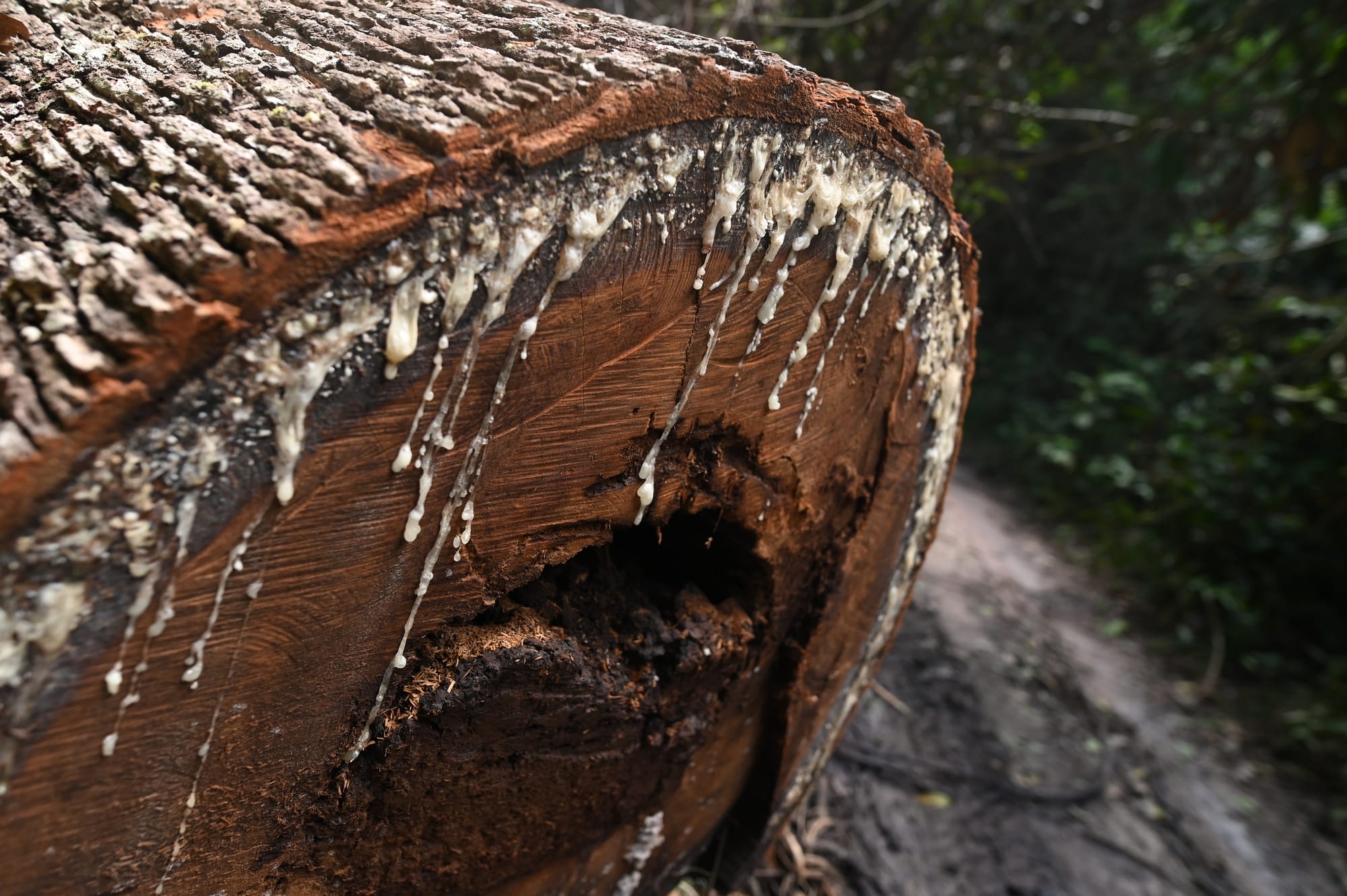
Can animism be a gesture of ecosystem conservation; restoration? If more eyes than we can see are watching, how different would we engage with the world around us?
Larger eyes, deeper ears, stronger hands. The hands making the wind move, the leaves transpire, the bees pollinate, the rivers carry nutrient-rich sediments down stream; fertilizing the land of the farmer, the table of the urban dweller who has never seen where everything comes from. Spirituality as story-telling: if every natural element embodies a story, how poor of imagination would we have to be to continue the current trend of being such narrative killers?
When outsiders come to take your land – turn your stories into plantations, your characters into open buffets for mining, side dish of bribing – where do the spirits go? Angered by the disrespect from the ones who look at trees only to see paper, leaves replaced by bank notes while the invisible guardians’ wrath is channeled towards the innocent indigenous instead of the uncaring tradesmen, the ones now forced to work in their own land as cheap daily labor, devoid of connection to the rituals that once shaped their existence and sense of place, what once informed their relationship with the natural world and its forces, gifts and kinship relations.
Morris Berman once said, "For more than 99 percent of human history, the world was enchanted and man saw himself as an integral part of it. The complete reversal of this perception in a mere four hundred years or so has destroyed the continuity of the human experience and the integrity of the human psyche. It has very nearly wrecked the planet as well. The only hope, or so it seems to me, lies in a re-enchantment of the world."
In Cambodia, everything starts in Arak Teuk and Arak Dei, respectively the spirit of the water and the spirit of the land. They craft not just what from everywhere sprouts and flourishes, but the relations between them. We can observe a trunk but not the rings of dead wood inside it, the colonies of insects that call it home or the networks of mycelium that for trees serve as telephone. We can't know anything that’s not-us in its totality, an object for ooo (object-oriented ontology) or a subject for the animists, is always a partially covered mystery, a way of seeing the world accepting its opaqueness while embracing the pragmatism of what is. Call it spirituality, call is nature, call it what is. The way a bat thinks that we will never understand, the sets of goals and priorities of a bamboo that we will never fully empathize with, in its tireless quest for verticality while keeping flexibility, or the careful decisions made by tree branches in their search for more sunlight, decorated with their curious turns and unexpected twists. So divergent from the individual dumbness turned into collective intelligence of ants, efficiently finding the quickest path to food and coming right back to pheromonalize it to the colony. A mystery, one where the reality of objects/subjects is always ready-at-hand. Each being existing by itself, fully alive and away, not depending on the interaction with us, but that, for humans, is mostly seen as a natural resource. A tool represented by its usefulness instead of its self-deserving presence, value defined by numbers instead of its complex web of interdependency with all surrounding beings. What if instead we could turn our focus towards the relations and the movement of the whole? The interconnected process of becoming(-with, as nothing grows in vacuum), with its murky processes of desire emerging from the inwards of every entity, the roots that want, that spread, burst through soil and rock and darkness, with precise sensors sniffing for moisture and nutrients, pumps and acids to dissolve even the hardest of minerals, but also collaborating with fungi to reach deeper and further, like old friends exchanging gifts in the form of water and food. A partnership extending as well to the communication with neighboring trees via signals through these fungi underground networks, or even above soil to the bird that comes to feed on mother seeds spreading them far and wide, unknowingly shitting green babies in a perpetual arboreal conquering project.
Perhaps animism is just a method of making sense of the Story. A narrative to digest the old tales from the complex non-human world already here and evolving way before us. Similar to the philosophers trying to dig on the field of deep ecology – where some see soul others see soil. How indigenous read these relations and weaved tapestry of divergent desires converging to a homeostasis in the ecosystem (if undisturbed enough by us), like the scientists dissecting it through numbers and words and stats towards a formalized skeleton of the ecological world we are all part of. But the flesh can also be there. The ‘sacredness’ not necessarily as a religious act but as something mystic, focused on quality instead of functionality, centered on embracing the veils instead of demanding answers. Those meaty hazed insides of plants' intentions, fresh with sap and bleeding wisdom from countless iterations out of evolution on how to best make peace with the rest. Survive and thrive, becoming-with instead of being separate, that ecolibrium disturbed by the ones who come looking at everything as resources, poor of imagination and seeing the invisible ties connecting everything. The affects between objects (for ooo) or subjects (for indigenous ways of seeing) that can also be seen as managed by the ‘middleman’ of forest spirits, the domino effects between the different species and materials down to the very atom. The quality of relations mediated by the expression of gratitude, reciprocity and reverence to this larger whole.
Perhaps spirituality can indeed be a conservation technique, refraining from greed to take only what we need. A will to believe because the pragmatic effect of the story is one that increases life itself, whatever that is. Embracing its mysteriousness to be re-enchanted and fall in love again with the world. Not as a romanticization of it, but as a necessity in this over-story we are living in, one in an imminent risk of global collapse.
It falls on us, the duty to write a better ending.