The treeing echoes
Circling back to the name for this collection of ramblings, rhizome, i.e. the way fungi networks expand underground outwards to all directions – because who needs a north star when your entire view of the world is nested under the soil? – an organized chaos filled with meanings and functions but devoid of hierarchies. Various thinkers explored this notion for our method of perceiving and organizing information, as we, recent little creatures on this planet in comparison with so many other living beings, always had to look around for the wisdom of trees and the entirety of the natural world, copying ways of being and using it for our own abstractions. From the root causes we give problems, to opening new branches as part of business models, being down to earth or having the memory of an elephant, working like a dog and borrowing from rivers to go with the flow, getting our heart rate up with a cliffhanger or getting trapped in slippery slopes. We make waves, we worry when situations are just the tip of the iceberg or when we get ourselves on thin ice. We are dependent on the concrete qualities around us even in the most abstract levels of discourse. The highest mind still needs the lowest toes to be on solid ground.
For instance Deleuze and Guattari, on the book A Thousand Plateaus, talk about using rhizomes as "a way to frame knowledge and data as a heterogeneous, non-hierarchical, non-linear process of assemblages", a multi-directional boundless map of stories where concepts do not necessarily need to be neatly separated by labels. We shouldn't forget, the walls that protect us are also the ones that separate us from all the rest. Indigenous communities often get in hot water with courts and the police for destroying fences companies built up in their forests, after yet another typical case of land grabbing with no respect for the traditional ways of non-ownership from the ones who lived there forever. A forest cannot be separated. We don't own nature, Nature owns us. And the animal migrations, the collection of non-timber forest products that indigenous people base part of their livelihoods and lifestyle, the pollination of flowers, none of the real tangible gestures of nature operating have any concept of borders, a never ending dance between different bodies, objects that belong to each other. Same as our ways of thinking, a riverly free flow of thoughts springing out from our brains, sadly dammed by mental categories we unimaginatively created. Stopping the stream of consciousness, another borrowed term from the natural world. This affects us in our little human affairs, but also impacts greatly our ways of connecting with the rest of the planet. Some people call it species loneliness, the state of isolation and disconnection, and the impact on our mental health simmering with the estrangement from the rest of creation.
As philosopher Levi Bryant once said: "in effect, the Copernican Revolution will reduce philosophical investigation to the interrogation of a single relation: the human-world gap. And indeed, in the reduction of philosophy to the interrogation of this single relation or gap, not only will there be excessive focus on how humans relate to the world to the detriment of anything else, but this interrogation will be profoundly asymmetrical. For the world or the object related to through the agency of the human will becomes a mere prop or vehicle for human cognition, language, and intentions without contributing anything of its own."
What if we significantly turn to other direction, fungi sniffing its way towards a more reciprocal relationship, a root without cause, just because. Rhizomes always serve as bridge-makers (or bridges always serve as rhizome-makers?), branching out from ego to ecocentric ways of seeing, being, perhaps becoming? Even this idea of being, a static entity applied to us and other living things, another neatly defined box of who we are or pretend to be. But everything is a process, our atoms keep changing, same for the movement of everything around us. A flux in a world of fluxes. You can never step in the same river twice. While rivering through life, becoming something else at every moment with our storyline coming from the compound effects of all the encounters and relations over time, the Buddhist and deep-ecology notions of interdependence and the anti-anthropocentric ways of knowing of object-oriented ontology and animism. We are the echoes of everything else. "We’re all in the soup of the biosphere, changing the flavors of all our other vegetable cohabitants. In this rhizome between organisms, traces of one another are produced. Guarrati points out the image of the wasp on the orchid that signifies this rhizome, this becoming-wasp inherent in that visual property of the orchid. In turn, the wasp is becoming-orchid through its participation as a part of the orchid’s reproductive cycle." *
Our body is an object, an ever changing one. But still bounded by some species limitations. We are human b̶e̶i̶n̶g̶s̶ becomings, unfortunately limited in our capacity of treeing or mushrooming. But not just in action, also in perception: "a human will experience an apple differently than the tree that produced it or the microorganisms that will decompose it." But we still hold the capacity to imagine, one of the good features we evolved to have. How could we think more like a mountain, brought up by a family made of millennia-observing stones? How would our decision-making be impacted if we could engage in more treeing behaviors, as someone who gives away fresh air, medicine, food and shelter in exchange of just water and sunlight? What could an ecocentric attitude of relating look like? Accepting the reality of interconnection of all things, embracing both the mechanics and the poetry of this world where everything has an intention and a gift to give.
"The saliva of the grazing buffalo causes the grass to grow taller."
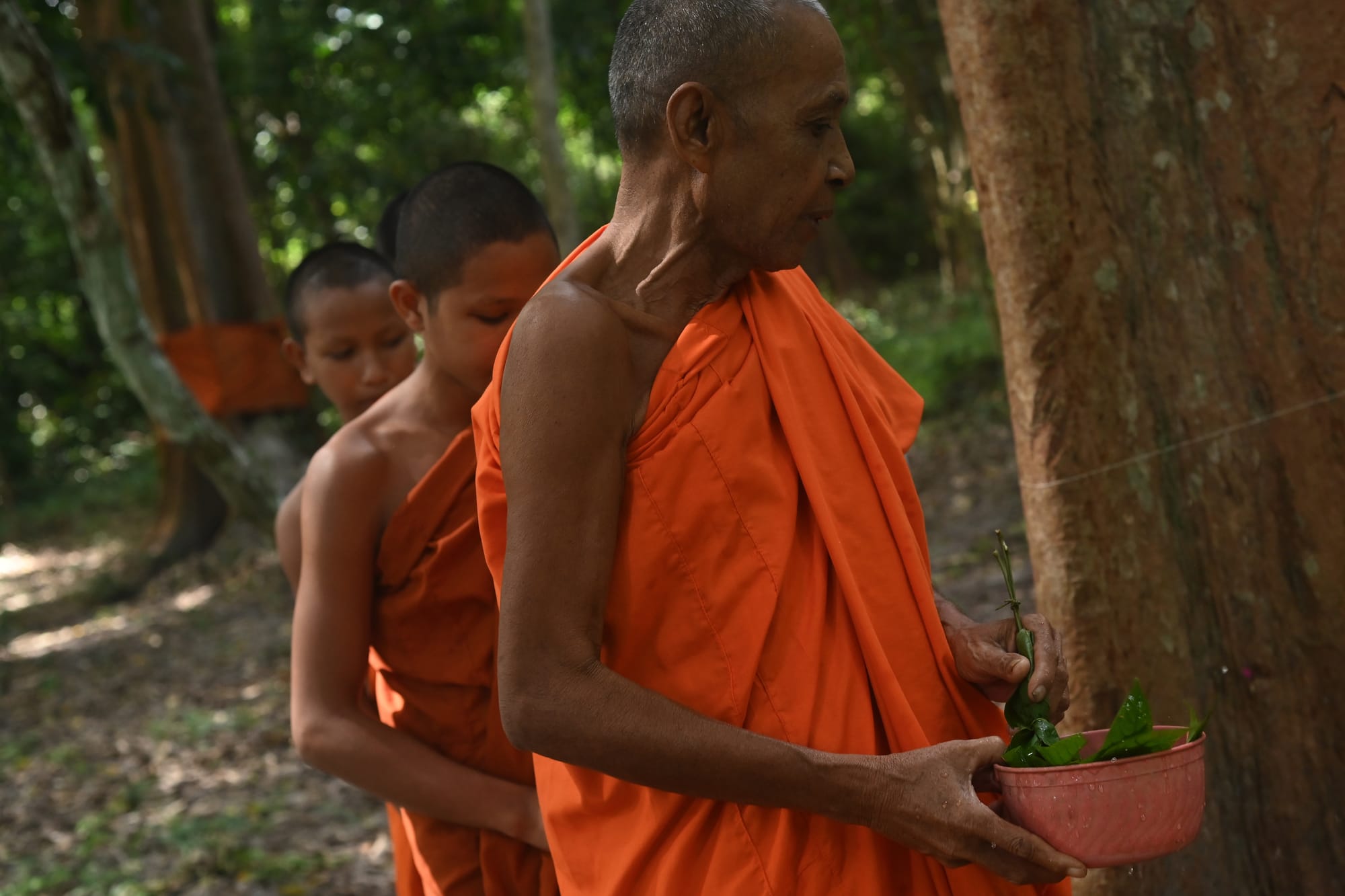
That river is not just a thing flowing as if the water is separate and just passing by. He is rivering, being himself and for himself, the flow is her way of being, her water as much belonging as the atoms and cells are belonging to us, but aren't exactly us. We can't step on the same river twice. Because if this river is an it, we have very few issues on connecting yet another wastewater pipe towards it. But if this river is a he or a she, we might treat the waters in a different fashion. Unfortunately this natural reciprocity, the freely giving and the mindful taking, has been forgotten by most, a practice maintained alive only in some indigenous communities not yet fully transformed by 'modern' forms of living. The buffalo needs the grass to scoop, and the grass needs the buffalo to poop. We need to engage more with trees in order to be able to becoming-tree and, in the process, perceive them as becoming-human. The grandmother we respect and honor for all she has given to us. To whom we light some incense, invite monks to give a prayer, be grateful for her generosity. The echoes resonate all over the forest,
we just need to pay attention
forgo the ego pretension
replace it with intention.
* If you would like to dig deeper in the soil of data visualization and ooo, this rhizomatic collection is an interesting one: https://medium.com/collaborative-synchronous-data-visualization/visualizing-from-the-rhizome-887dea18897